Conditions for storing dates in warehouses and cold storage
Dates are one of the most valuable agricultural products in tropical countries, especially Iran. In addition to its high nutritional value, this product also has a large export market. However, one thing that many producers, sellers, and even consumers do not pay enough attention to is the correct storage conditions for dates.
If dates are stored in inappropriate conditions, they will quickly become sugary, moldy, sour, dry out, or subject to pest infestation, and will lose a large part of their quality and economic value. For this reason, it is very important to understand the principles of storing dates in warehouses and cold storage.
In this article, we will examine in a complete and practical way the best storage conditions for dates, the appropriate temperature, humidity level, packaging principles, and important storage tips.
Why is it important to store dates properly?
Dates are a semi dry and sensitive product that reacts strongly to changes in temperature and humidity. If this product is stored in substandard conditions, it gradually loses its appearance and taste, and problems such as the growth of fungus and mold, the formation of sugar on the surface of the dates, the absorption of unpleasant odors, and even the attack of insects and storage pests arise. These factors not only cause premature spoilage of dates, but also reduce their economic and export value, and ultimately cause significant financial losses to producers and sellers. For this reason, observing the principles and standards of proper date storage is very important because in addition to maintaining the quality and freshness of the product, it will increase its shelf life and bring greater profitability.
Suitable temperature for storing dates
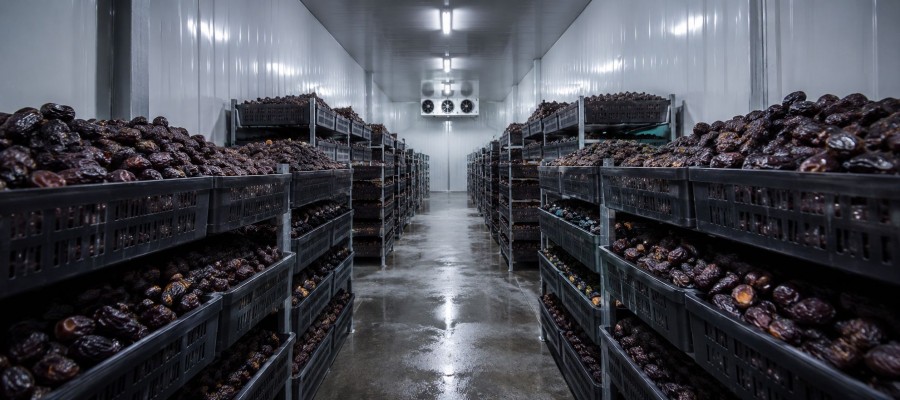
The storage temperature of dates plays a very important role in maintaining the quality, taste and shelf life of this product, because dates and dates are sensitive to heat, humidity and temperature changes and if stored improperly, they quickly deteriorate, mold, dry out or lose quality. For storing dates, a temperature between 0 and 5 degrees Celsius is usually recommended so that the product can maintain its freshness and quality for several months. However, for long-term storage and especially for export, the use of a cold store is essential. In these conditions, the standard cold store temperature is usually between minus 5 and 4 degrees Celsius to stop the activity of insects and pests, reduce the growth of fungi and mold, and preserve the natural color, texture and taste of the dates. If dates are stored properly in these conditions, they can be preserved for between six months and a year with good quality.Of course, the temperature of the cold store should not be lower than minus 5 degrees Celsius, because excessive cold can cause frostbite and reduce the quality of the dates, which is why precise temperature control is very important in storing dates.
Suitable humidity for storing dates
Humidity is one of the most important and sensitive factors in storing dates and has a direct impact on the quality, shelf life and health of the product. If the humidity level is too high, the likelihood of fungus and mold growth increases and the dates will ferment, sour and spoil. On the other hand, too low humidity also causes the dates to dry and harden, gradually reducing the weight and quality of the product. For this reason, for proper storage of dates, a relative humidity of between 65 and 75 percent is usually recommended to maintain the texture, taste and freshness of the product. Accurate humidity control in warehouses and cold stores is very important and it is best to check it regularly using moisture meters to prevent quality loss and damage to the product.
Important principles for storing dates in storage
Proper ventilation
The date warehouse must have proper air circulation and adequate ventilation to prevent moisture accumulation in the environment, as stagnant moisture can provide conditions for mold growth and date spoilage, reducing the quality of the product.
Avoid direct sunlight
Sunlight can have a significant negative impact on the quality of dates, as it changes the natural color of the product, increases its temperature, and consequently reduces the quality of the texture and taste of the dates. For this reason, it is recommended to store dates in a dark or very low light environment to maintain their quality, freshness, and nutritional value.
Maintaining warehouse cleanliness
The date storage environment must be completely hygienic and controlled to prevent the entry of pests, insects, and rodents, as these factors can cause contamination and reduce the quality of the product. To maintain proper conditions, it is necessary to periodically disinfect the warehouse, use screens and pest control equipment, and prevent dust from entering the environment so that the dates are stored in healthy and standard conditions.
Distance from the ground and wall
Date cartons and boxes should not be placed directly on the ground, but rather on pallets for proper storage and at least 20 cm distance from walls should be considered. This improves air flow around the product and prevents moisture from transferring to the packaging, thus preserving the quality and shelf life of the dates.
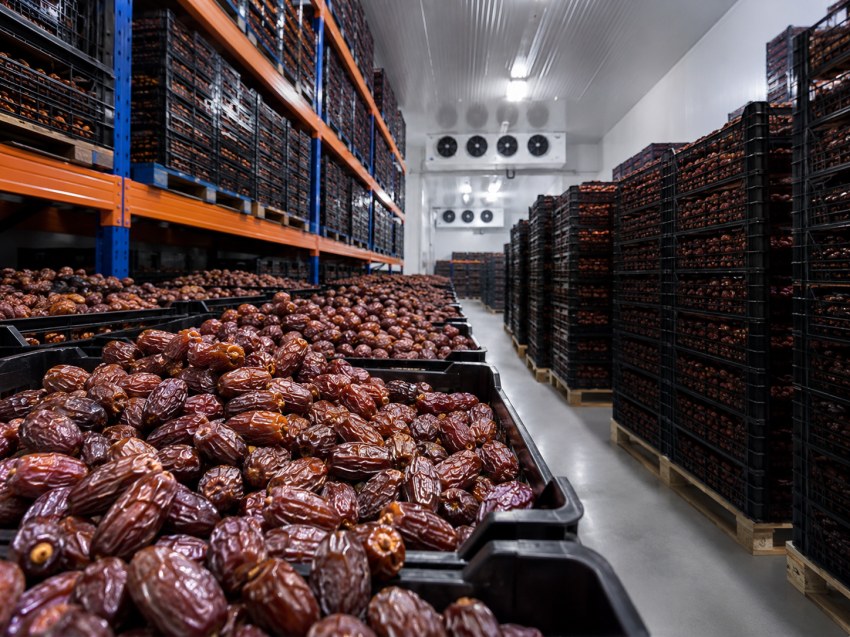
The best packaging for storing dates
Proper packaging is one of the most important factors in maintaining the quality and increasing the shelf life of dates, because in addition to physically protecting the product, it plays an important role in preventing the penetration of moisture, air, dust, and environmental pollutants. A standard package must be completely hygienic and suitable for food, have sufficient resistance to moisture, prevent air from entering, and at the same time have the necessary strength for transportation and handling so that the dates are not damaged along the way.
The date industry uses a variety of packaging, each with its own specific application; including hygienic plastic containers that are suitable for domestic consumption and small packages, multi-layer cartons that are used for more economical transportation and storage, vacuum packaging that significantly increases the shelf life and preserves the taste and freshness of dates by removing air, and export boxes that, in addition to protecting the product, create an elegant and professional appearance for foreign markets. Using appropriate packaging not only preserves the quality of dates for a long time, but can also increase their shelf life many times over and significantly increase the commercial value of the product.
How long do dates last?
The shelf life of dates depends on the type of date and the environmental conditions of its storage, and the more the temperature and humidity are controlled in principle, the longer the product will last. At room temperature, dates can usually be stored for 1 to 3 months, but in these conditions, the likelihood of quality loss and problems such as drying or mold will be greater. If stored in the refrigerator, this period increases to about 6 to 12 months and the quality of the dates is better preserved.
However, the best conditions for long-term storage are the use of industrial cold storage, where dates can be stored for more than 12 to 24 months without a noticeable loss of quality. Of course, it should be noted that the type of date also has a great impact on shelf life. For example, soft dates such as Mazafati dates are more sensitive to temperature changes and require colder and more controlled conditions to maintain their quality, taste and texture.
summary
Proper storage of dates in warehouses and cold storage is the most important factor in maintaining the quality, taste and economic value of this product. Proper temperature, humidity, ventilation and packaging control can significantly increase the shelf life of dates and prevent possible damage.
If date producers and sellers follow standard storage principles, in addition to reducing waste, they can offer a higher quality and competitive product in the domestic and export markets.